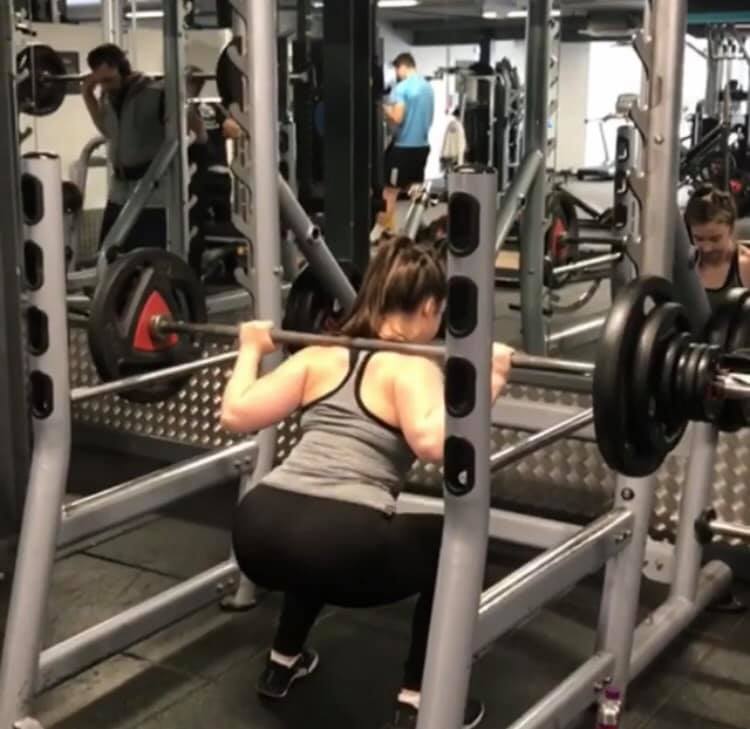
Bodyweight to Barbell Squats

I would like to start off by pointing out that there is not a single textbook way to do a squat, or most exercises for that matter. We are all different shapes and sizes, no one is completely symmetrical, the structure of our anatomy is different from person to person. ⁣Think about it, some people have wider hip sockets, some narrower; some people have a greater hip range of motion, others not so much; some people have longer femurs and others shorter. You get my point?

So why does it make sense for everyone to squat the same way?⁣

It doesn’t. ⁣

It’s about fitting the exercise to the person, not the person to the exercise. Playing around with stances and movement patterns to find the most comfortable and safest way for you to move and reap all of the benefits from the exercise. ⁣

So don’t worry if your squat isn’t textbook perfect, mine isn’t. My right foot tends to drift out to the side like a penguin. I still move well, it doesn’t cause me any discomfort, and I can still squat 100Kg. 

ANYWAY. 

Let’s talk about how to squat, and how you can progress from body weight squats to barbell squats. You’ll be dreaming about squats and barbell back flips.

The TRX Squat

If you find yourself lacking strength and stability with unassisted body weight squats, then the TRX Squat is a great place to start. By holding on to the TRX, you can use your arms to help pull yourself up to compensate for the weaker muscles. The straps are also going to help you sit back onto your heels compared to if you weren’t holding on to them, which in turn ensures that your knees don’t track excessively beyond the front of your toes.

As you progress, you should be able to minimise the use of the straps for support, so that all strength of your squat is coming from your legs.

A few general checkpoints are:

  1. Make sure your knees are pushed out at all times.
  2. Brace your core so that you have a nice straight line going down your back. 
  3. Sit back on your heels so you don’t come up onto your toes.


TRX Squat

Unassisted Body Weight Squat

By now you have the strength and stability to squat without the support of a TRX, so its time to look at unassisted body weight squats. 

Here’s a generic idea of how to squat.

  1. Stand with your feet about a shoulder width apart and have your toes facing forward.
  2. Your feet are the base of your support, so you want to make sure you create a strong stable foundation with your feet to keep your knees and hips in proper alignment. Your feet must be on the floor at all times; as you lower into your squat, sit back on the heels of your feet and push through the outside of your feet.
  3. Brace your core at all times, ensuring you have a nice straight line down your back. Practising bracing your core at this stage is going to help you a tonne whe it comes to knowing how to brace your core when you’re squatting load.
  4. On the way up and down, make sure you’re focusing on pushing your knees out, and they’re not caving in.
  5. Aim to squat at least parallel.

Like I said, this is a generic idea of how to squat, as it always depends on each individual circumstance. However, some aspects are more or less non-negotiable: your knees should be pushed out at all times, your core should be braced, your feet should be on the floor at all times.
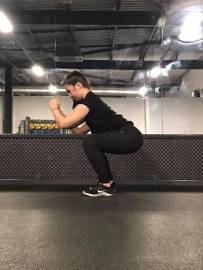
Bodyweight squat

Dumbbell Front Squat

The dumbbell front squat is a great way to start getting used to squatting with load when you squat, without jumping straight to a barbell on your back. You’ll start to get a feel for what it means to brace your core now that you’re squatting with load. A barbell usually weighs 20Kg; using a dumbbell you can gradually build up your strength and confidence starting with a lighter load and increasing the weight over time. You can also use a kettle-bell instead.

Front squats differ to back squats in that the placement of the bar/dumbbell means that the recruitment of each muscle is slightly different. For example, both front squats and back squats recruit the hips, hamstrings, glutes, quads, lower back and upper back, but front squats zone in more on your quads compared to back squats. We’ll discuss more on barbell front squats in another article.
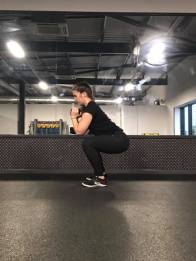
Dumbbell Squat.jpg

The Smith Machine Squat

The smith machine squat can be beneficial, because the bar is attached to the rack, meaning that you can still focus on developing your squat strength and form without the added stability challenge; with the bar just travelling up and down rather than forward and back in a more unwieldy motion (you don’t need to worry about falling).

In addition to this, the smith machine squat will also allow you to target muscles more specifically, by adjusting your foot placement. For example by moving your feet forward; the barbell back squat won’t always allow this.

When I’m working with my clients, I find the majority of them are good to go straight into back squats once they’ve developed their strength and fine tuned their form with the previous squat variations. It will help having me by their side to keep an eye on their form and to make sure the barbell doesn’t go anywhere. If you’re confident enough that you’ve built up enough strength, fine tuned your form and can brace your core under more load then by all means, give the barbell back squat a go.
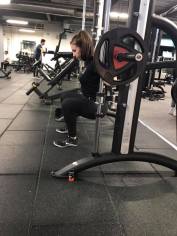
Smith Machine Squat.jpg

The Barbell Back Squat

The Set Up

  1. The first step is to get the barbell into position. Set the bar on the hooks at roughly shoulder level and add the desired weight. Don’t forget to factor in the weight of the bar.
  2. Stand under the barbell with your feet about a shoulder width apart, with the centre of the bar in the middle of the fleshy part on your upper back.
  3. Grip the bar with your hands at an equal distance apart from the centre of the bar.
  4. I like to squeeze my shoulder blades together to create a firm shelf-like surface barbell to sit on.
  5. Brace your core before un-racking the barbell. Take a deep breath in into your stomach and brace your abdominals as if you’re about to get punched. At the same time, pull the barbell down into your upper back. You want there to be tension everywhere, right from the get go.
  6. Un-rack the barbell and give yourself a few steps to get into your squat position.
  7. Look at the floor just in front of you. Not straight down, not up at the ceiling, not straight ahead in a mirror.

The Motion

  1. Before lowering into your squat, take another deep breath and brace your abdominals.
  2. Sit down into your squat by imagining you’re sitting down on a stool. Sitting back on your heels, push your hips back and bend your knees until you have reached your end range of motion. I like to aim for at least parallel.
  3. On the way down and up, you want to make sure there is a nice straight line down your back and your knees are pushed out.
  4. Stand up and return to the start position, making sure your knees are pushed out.
  5. Pause briefly to re-set your brace and repeat for reps.
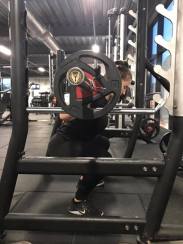
BB Back Squat

There you have it. You now have a guide on how to progress your squats right from using a TRX for Assistance all the way up to having a barbell on your back. The main thing is to take your time; there is no need to rush each stage; there is no need expect yourself to nail the technique and strength aspect first time; there is no need to compare yourself to anyone else. Stay consistent, enjoy your training and you’re confidence will just grow and grow and grow. You’ll be barbell back-flipping in no time.

Combat Your Cravings For Good

CRAVINGS! They’re a pain in the arse right? I know the feeling. You’ve got your heart set on some big goals for yourself to loose weight and you have the best intention to give it your absolute all. You’ve psyched yourself up, ready to hit the gym, nail your nutrition habits, and hope to make linear progress, hope that everything runs smoothly for you. You can almost picture how you’ll look and feel once you’ve reached your goals. Out of nowhere comes these cravings. Sometimes they’re mild and you have the willpower not to give in. Sometimes they’re intense as f*** and you feel like you’ve crumbled by giving in. You feel like all your progress has gone down the drain and you think “what’s the point in carrying on?”.
 
Let me tell you, it doesn’t have to be that way. I’m here to be your coach, your guru, your guide to combating your cravings for good.
 
Let’s start by talking about what a craving actually is and how it is different to hunger.
 
A craving is a state of heightened eating motivation that is directed at a specific food. Hunger is a non-specific motivation for calorie containing food.
 
It’s just our luck that cravings are non conscious, meaning we cannot control when or how we experience them. The good news is that we can learn to control our behavioural response to cravings.
 
So how exactly to we get cravings?
 
As with a lot topics in the scientific world there may not be a definitive answer, however lets take an evolutionary perspective from Dr. Stephan Guyenet that gave me a few light bulb moments.
 
Us humans are like bio-computers. We have an intrinsic motivation for carbohydrates, fat and protein and the ability to learn which foods supply them. When you’re chowing down on meals throughout the day, the food we eat goes through a process of digestion and part of that process means our food eventually ends up in our small intestine. In the small intestine are receptors that respond to sugar, starch, fat, protein, salt; these receptors send signals to the brain about what you’ve just eaten and a response is created.
 
An area in your brain is activated which produces dopamine. Dopamine is a key neurotransmitter involved in cravings, but it is not the only one.
 
Over time we’ve got really good at extracting fats, sugar, salts etc. cheaply and combined these to create foods high in fat and sugar (chocolate, cakes, cookies). Exposure to these over time means that new neuro-adaptations are created that activate a reward response. Throughout our whole lives, we become motivated by the sensory stimuli from food. Dopamine spikes happen for all foods but certain foods drive this cycle more than others. We have the ability to tune motivation levels to match the value of an item because the amount of dopamine released is proportional to the concentration of nutrients being detected in the gut.
 
Which foods trigger cravings the most?
 
Foods that trigger the most dopamine release should trigger cravings the most. These foods have a high concentration of sugar, starch, fat, protein and salt, especially when combined. For example, chocolate, cake, cookies, pizza burgers, ice cream. These can be compared to foods that aren’t commonly craved such as apples, carrots, bread, beans, rice cakes.
 
Foods that are commonly craved are generally high fat and savoury (crisps, meat, cheese) or high fat and sweet (cake, chocolate, cookies). The foods we crave less often are low fat and sweet such as dried fruit or low fat and savoury such as vegetables, bread, rice cakes.
 
Tips for combating cravings for good!
 
1)Limit cue exposure. You’re going to be less likely to give into your cravings and more likely to control your behaviour if you don’t go down the sweet isle at the shops or if you avoid the junk food in the kitchen.
 
2) Eat whole, complete meals focusing on simple and unrefined foods. Most cravings are simply dopamine reinforced motivations from foods that have a high concentration and mixture of sugar, starch, salt, fat, protein. By continuing to eat foods like that you’re more likely to create and maintain cravings.
 
3)Let yourself forget. Cravings can be considered to be “learned” and therefore we can unlearn our response to certain food by eliminating that particular food from our diet. This way we somewhat forget the reward response we get from eating foods such as chocolate, cake, crisps etc.
 
4)Keep hydrated. Cravings as a result of severe hunger may be mistaken for dehydration.
 
5)Reintroduce desired food into diet. Yes this point contradicts my third tip, however we must remember there is never a one sized fits all approach to health and fitness. Some people find that gradually reintroducing the desired food(s) into their diet in a controlled manner helps eliminate/reduce their cravings for these foods because of the lack of restriction. This is because food restriction may increase reward sensitivity.
 
6)Practice mindfulness. What I mean by this, is that when you have a craving, don’t just jump straight into the desired food. Pause for a thought and ask yourself: do I really want to/need to eat this food? Am I actually hungry or is this just a craving that will pass? Is there a way I can get myself away from temptation? Similarly, when you are eating food, just take a few moments to enjoy what you’re eating. Enjoy the taste, texture, smell, the feeling of being fuelled with energy. Take time to actually appreciate what you are eating rather than just mindlessly eating.
 
7)Get enough sleep. Sleep deprivation starts as soon as you get less than 7 hours sleep. One example of how lack of sleep can affect cravings and hunger is because sleep deprivation changes the timing and release of hormones which control our appetite. When we’re sleep deprived, a hormone called ghrelin is released in larger amounts. This hormone tells your brain that you’re hungry. Our bodies also release a satiety hormone called leptin which tells our brain we are full. During sleep deprivation leptin gets released in smaller amounts. As a result of the changes in leptin and ghrelin, you may find yourself feeling hungrier, and when full your body may not recognise that its time to stop eating.
 
As always there we must always take an IT DEPENDS approach to our health and fitness questions.
 
Now you are armed and ready with heaps of information and tips, you now have a full proof tool kit to combat your cravings for good!

Don’t be a fairy

So many of us women want to go through a transformative process that often sounds like this: “I want to lose weight and tone up”.

Why do we want to do this?

A lot of the time it’s because we don’t feel the way we’d like to feel about ourselves. We lack self confidence. We want to feel good in certain clothes. We want society’s approval of how we look. People can feel so lost in finding any form of self confidence that they look for something that resonates with them and who they strive to be elsewhere. Namely, social media.

. *see’s a fit chick on Instagram
. “Wow I’d love to look and feel like her”
. *clicks follow
. * buys Instagram girl’s merch
. * forgets about themselves
. * makes no real progress

Obviously this is a slight exaggeration but you get the idea.

So many women try to undergo a transformative process. They try so hard but fail time and time again. Why?

1. They spend too much time idolising Instagram girls, wishing they could be like th.
2. They spend too much time playing with their hair and makeup at the gym trying to look pretty
3. They spend endless hours in the gym doing stuff that doesn’t work. Not really knowing what they’re doing, or why they’re doing it.
4. They’ve never taken the time to seek help and advice from a professional.
5. They’re too focused on the end vision of how they’ll look.
6. They freak out and jump ship when they see the scales go up.

My job isn’t about dictatorship or simply knowing what to put in a programme. My job is about making people want to train, make them trust in my guidance and most importantly, make them enjoy the process. The problem isn’t “How can I lose weight and tone up?” The problem is “How do I want to do the work and make time to do it?”

Deciding you want to begin a transformative journey is about first having your mind set and focused on your goal, but rather than being focused solely on that end vision, you must focus on what you need to do now, today. The “magic” lies in honing in on the experience, the enjoyment. It’ll be seemingly easier than it will be if you’re fixated on scale numbers, unsustainable diets and that very end vision of how you will look at feel. [would edit this to say : “This way, it’ll seem easier than if you’re fixated…”)

Truth is, you will never be like that girl on Instagram. It’s an unrealistic goal to have and will immediately set you up for failure.

It’s all about you. You must be confident in yourself and your willingness to learn and make a positive change. It doesn’t matter if you can’t do a push up, or a squat, or a triple backflip. What matters is being focused on what it takes to get where you want to be.

It’s not about consistent motivation or perfection. It’s about determination, being consistent in your efforts and making the most of your resources. Focus on what really matters. Your lifestyle, developing positive habits, your mental health. It’s a mental transformation as much as it is physical.

I’ve spent years doing all sorts of strength training bits and pieces. First focusing on athletic performance to keep me light yet fast and powerful to fight -61Kg. Then I decided I just wanted to build muscle and get strong AF. I wasn’t worried about the scales or weight categories anymore. Now I’m in the process of wanting to shed some fat to show some muscle.

I sweat shit loads. I make funny faces when I’m trying to push a few more reps out. My hair falls out of my pony tail. I get the shakes. I occasionally want to cry. But that’s okay, because I don’t show up to training to look pretty. I show up to put in the work even if I’m not feeling 100%.

It’s a mad journey, but you need to be honest about your goals and tap into the emotions of why you want to achieve them.

So what’s the takeaway message?

Don’t jump ship just because something isn’t quite how you expected it to be.
Take time to pause throughout your journey and appreciate where you’re at. It’ll instll a lot more drive and determination than idolising an Instagram chick ever will. Be strong mentally and physically. Don’t be a fairy

Enhancing your Success at a Sporting Event

So its the the day of your sporting event. It could be martial arts, a dance show, football, it might even be an ultra-endurance event. Leading up to the event you’ve put in countless hours of training, developed solid eating habits and you’ve probably experienced and overcome a shit tonne of obstacles.

Its the day of your event. You find you haven’t performed as well as you could have. I use the word performed, because the end result (whether that be a gold medal or no medal) is not indicative of ones performance.

In my experience, I have entered competitions where I have fought through a tough 4 or 5 rounds to walk away with a bronze medal. That means a hell of a lot more to me than if I show up to a competition and am practically handed a gold medal with only a fight or two.

What causes an unexpected dip in performance on the day could be a whole range of things: poor nutrition, lack of sleep, nerves, an injury, an improper warm up. The list goes on. From my experience, the main culprits hindering an individuals performance on the day of an event are poor nutrition, an improper warm up and nerves.

Proper Nutrition

It is worth noting that your performance will not be significantly enhanced if you only eat properly on the day of the event. So lets assume you’ve been bossing your eating habits leading up to the event.

First and foremost, when planning meals for the day of the event, stick to foods your body is familiar with. The day of the event is not the right time to be experimenting with new food choices.

A key reason to eat well on the day of your event is to prevent low blood sugar levels and its symptoms: dizziness, nausea, fatigue and muscle weakness.

To begin your day, choose a breakfast high in complex, non-refined carbohydrates to keep glycogen stores full, in order to make the most out of your warm up and performance. Complex carbohydrates pack in more nutrients than simple carbohydrates, because they are high in fibre and digest more slowly, thus making them more filling. When they are digested, carbohydrates are broken down into glucose to provide readily available energy for the body to use quickly and efficiently. Opt for single ingredient foods when preparing your meals: fruits, beans, nuts, seeds, legumes etc. Some of my favourite breakfast choices include overnight oats, porridge and homemade granola.

During the day, keep your energy levels topped up by fuelling yourself with snacks and meals based around single ingredient foods and fewer refined ‘fake’ foods.

Although an athlete may have the best of intentions, sometimes they feel they’re unable to eat before an event due to eating making them feel ill or giving them an upset stomach. If you fall into this category, be sure that you eat well the day before and early on the big day.

So how will all of that actually help?

  • Prevent fatigue
  • Aid concentration
  • Ensure the best recovery after the event
  • Make you feel like a superhero!

Warm Up

“Warm up!” Sounds obvious doesn’t it? However its surprising how many different reasons I’ve heard as to why people don’t warm up.

  • “I don’t want to waste my energy”
  • “I’m too tired”
  • “I don’t know what to do”
  • “Oh I just go out there and see what happens”

My number one tip for overcoming all of the above statements is PLAN YOUR WARM UP. Don’t just go out there and see what happens. Your warm up should include techniques you are confident with and ones that you are going to use. Don’t waste your time trying to learn a new technique, this is unlikely to have any real benefit when it comes to your performance. Don’t worry about flash, fancy techniques. Use what you know works for you and keep it simple.

I tend to raise an eyebrow or two when I hear people say “I don’t want to waste my energy”.

A good analogy to use  is a car engine to warming up on a cold day. As the car warms up, the fuel and oil become more viscous and so it’ll flow better. Therefore, the moving parts of the engine glide past each other more smoothly and the system performs more efficiently compared to just pressing the accelerator to the floor immediately.

Planning a proper warm up will ensure you are using your energy more efficiently and you are less likely to fatigue prematurely. Your heart rate should gradually increase, resulting in more oxygen being transported through your blood and used within the working muscles. An increase in body temperature will result in an improved range of motion around your joints and you will get close to your optimal efficiency.

It is very easy to get distracted and watch other individuals warm up and try and suss out your competition, but this shouldn’t be your focus. Get into your zone and prepare yourself psychologically as well and physically.

How can you do this? Listen to your music to shut off what everyone else is doing. Visualise your strategy and the techniques you are going to use. If you can visualise something you can attain it.

Dealing with Nerves

Pre-event nerves can come from a range of different sources: how good your opponents are, how important the event is, who your opponents are, winning or not, who is watching etc. Whilst there is a long list of things that can make you feel nervous, the true cause isn’t anything I’ve mentioned, but it’s you! Yes, you make yourself nervous. What is important here is not what is happening externally, but rather internally.

Here’s what I mean. It isn’t the size, skill or reputation of an individual that makes you nervous. It’s how you respond to them and what you say to yourself leading up to the event. Feelings of nervousness are cause by our internal response to the things that are going on externally. If you can make yourself nervous, then you have the ability to change your response.

  1. Keep your focus in the present. Don’t allow your focus to fast forward or rewind to the past. If you want to feel relaxed, you must learn to keep your focus on the present and recognise when your focus is time travelling and bring it back to the present.
  2. Have fun. Enjoying what you do is the secret to staying calm and performing your best. Too much pressure can result in you being too serious and your skill set can start to disappear. Enjoy the event and embrace the challenge of a tough opponent. Trust your intuition.
  3. Breath. Whenever you’re feeling stressed in the hours or minutes leading up to your event, switch your focus to your breathing. Slow and deepen your breathing to get rid of any trembling or intrusive thoughts.

So in a nutshell, eat properly, warm up and control your nerves.

Sounds vanilla right? You’ll be surprised how many individuals aren’t doing these three things or at least aren’t doing these three things properly.

Are you?

Remember, it’s focusing on the minute details of the simple stuff where you’ll really maximise your performance gains.